Ask a front-desk manager at a 40-room hotel what their property management system does, and you'll hear a list of features they paid for and never use. Ask what went wrong last weekend, and you'll hear something else entirely: the towel request that never reached housekeeping, the minibar charge nobody posted, the guest who waited twenty minutes at checkout while three bills were reconciled by hand.
We built The Vestly around the second list. This post is what we learned about what a hotel PMS actually needs — and what it can safely leave out.
Start with the request, not the reservation
Most PMS products are organised around the booking. That makes sense for a chain's revenue team, but it isn't where an independent property feels pain. The pain lives in the thirty small requests a day that move between a guest, the desk and the floor.
So The Vestly starts there. A guest scans a QR code in their room, picks a category — housekeeping, room service, maintenance, concierge — adds a note and sends it. No app to install, no login. The request lands on the right team's board with the room already attached and a timer running.
Two design decisions did most of the work:
- No app download. Every step you add between a guest and a request loses a few guests. A web page opened from a QR code is the shortest path we know.
- The room travels with the request. Staff never have to ask "which room was that?" because the request was created from inside the room.
WhatsApp is not an operations tool
Almost every property we spoke to ran part of its operations on WhatsApp groups. It's free, everyone has it, and it works — until it doesn't. Messages scroll away, nobody knows who owns what, and there's no record when something is missed.
The fix isn't to ban WhatsApp. It's to give requests an owner and a clock. In The Vestly, every request has an assignee, a status and an SLA timer that escalates on its own when it runs over. That one change turns "I think someone's on it" into a board the manager can read at a glance.
A request without an owner and a clock is just a message.
Housekeeping needs one board, not a register
Room status is the heartbeat of a hotel: occupied, vacant, dirty, inspected. When that status lives in a paper register at the desk, it is always slightly out of date.
We gave housekeeping a floor-by-floor board they update from any phone, synced instantly. Open requests are pinned to the room so nothing is forgotten when a room turns over, and the front desk sees a room flip to ready the moment it's inspected. There is nothing clever about this. It just has to be fast and impossible to get wrong.
Billing should happen as the stay happens
The checkout scramble has one root cause: charges live in different places. Room charges are in the PMS, the restaurant has its own POS, the spa writes on a slip, and someone reconciles it all while the guest waits.
In The Vestly, chargeable requests and POS orders post straight to the guest's folio as they happen. Taxes are calculated by region — GST in India, VAT or city taxes elsewhere — so the bill at checkout is already right. Split folios, deposits and refunds are built in, because a spreadsheet is where billing errors breed.
If you're evaluating any PMS, ask one question: when a guest orders breakfast to the room, how many people touch that charge before it's on the bill? The right answer is zero.
Reservations: one calendar, every channel
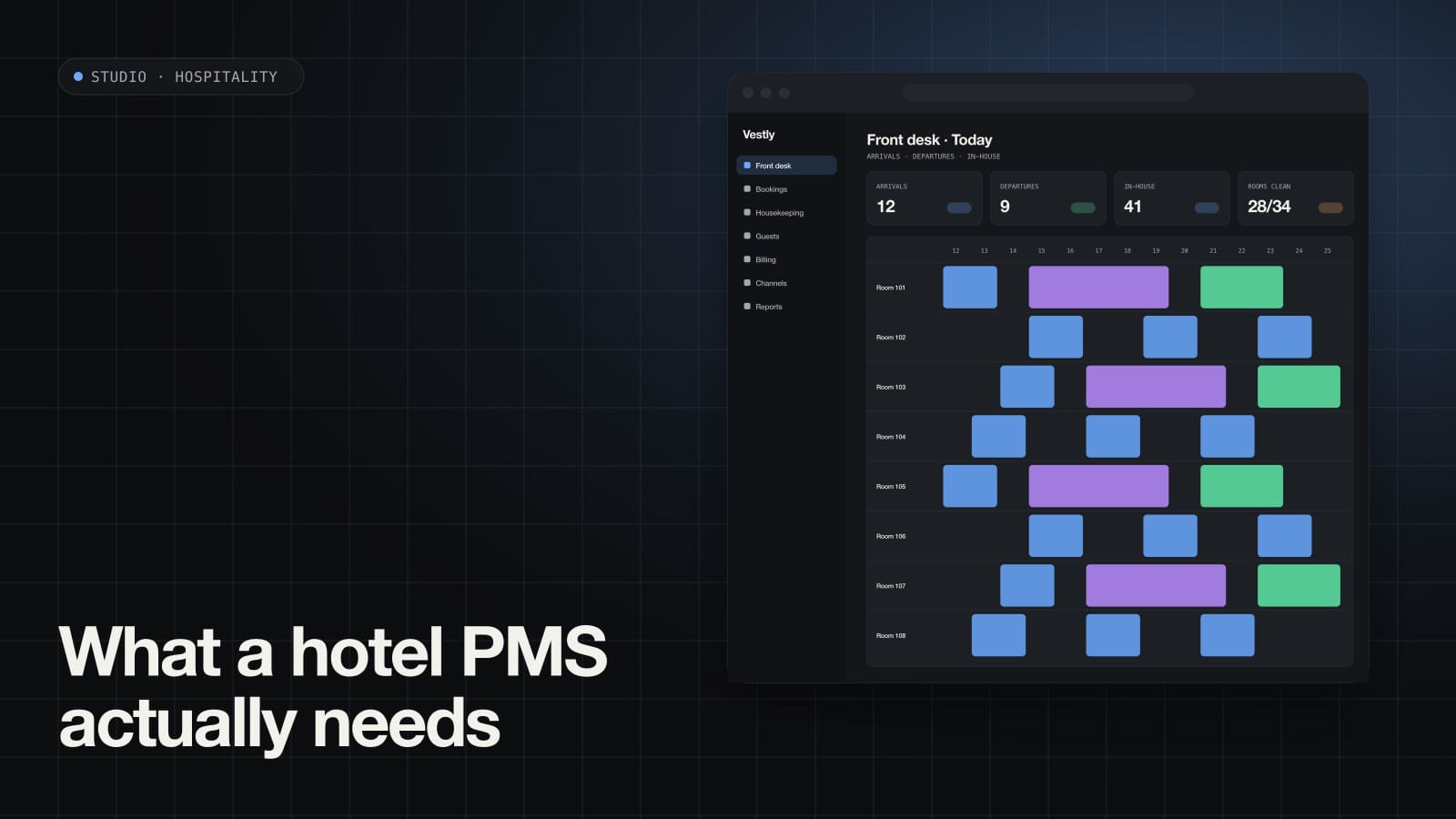
Independent hotels sell through a mix of OTAs and direct bookings. The job of the reservations screen is simple to say and hard to do: one calendar with Booking.com, Expedia and direct bookings in the same view, drag to reassign rooms, and availability that updates everywhere.
Guest history should follow the guest across stays. It's a small thing that makes a returning guest feel remembered.
What we cut on purpose
Chains need features independents don't — and every unused feature is a screen someone has to learn. Here's what we deliberately kept out of the core product:
- Deep configuration. Most properties go live the same day: print the room codes, add the staff, start. If a feature needs a training manual, it's probably not core.
- Per-module pricing. The Vestly has one plan that includes the whole operation, with unlimited staff accounts. Pricing by module encourages properties to skip the parts that would actually help them.
- A separate app for staff. Staff use the same web app on whatever phone they have.
Multi-property without the enterprise tax
Growing groups often run two or three properties before they can justify an enterprise system. The Vestly is multi-tenant from the ground up: one login for the owner, isolated data and teams for each property. The architecture is the same whether you run one hotel or fifty — which is exactly why it's affordable at one.
What this taught us about client software
Running our own SaaS product changes how we build for clients. We think about the Monday-morning support call before we think about the launch demo. We measure a feature by whether staff use it unprompted. And we're suspicious of anything that needs configuring before it's useful.
If you run a property and any of this sounds familiar, see The Vestly — or tell us about the operation you'd like to fix.
Leave a Reply